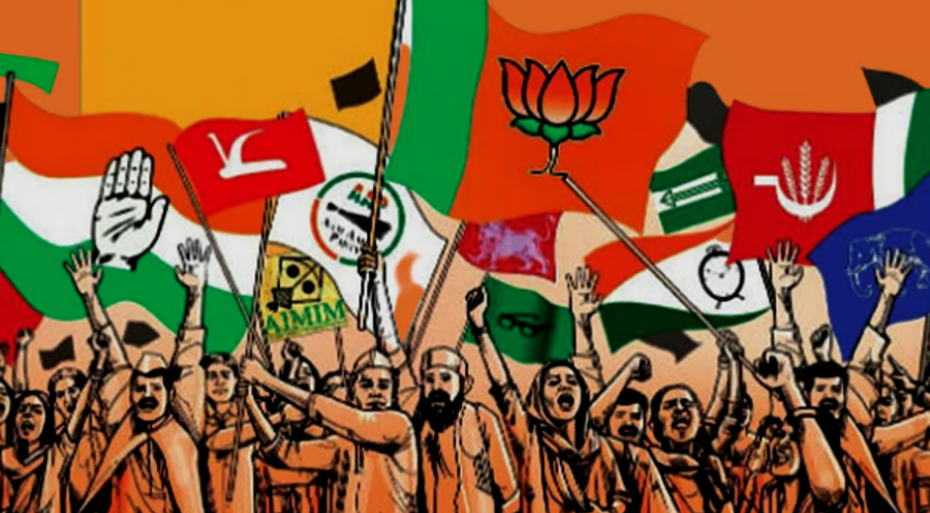
Political parties are an important part of democracy. They help people to choose their representatives and form governments. In a democracy, different parties present different policies and programmes so that people can make a clear choice. Without political parties, democracy cannot function effectively.
Introduction
What is a Political Party?
A political party is a group of people who:
- Come together to contest elections
- Hold similar political ideas and policies
- Aim to gain power and run the government
👉 A party tries to persuade people that its policies are better than others.
Main Components of a Political Party
A political party has three parts:
- Leaders – top decision-makers
- Active members – work for the party
- Followers (supporters) – vote for the party
Why Do We Need Political Parties?
Political parties are necessary because they:
- Make elections meaningful
- Help people choose leaders
- Form and run the government
- Shape public opinion
- Act as a link between people and the government
Without parties, democracy cannot function properly.
Role of Political Parties in Democracy
Political parties:
- Contest elections
- Put forward different policies and programmes
- Make laws in the legislature
- Form and run governments
- Oppose the ruling party and check its power
Topic-1: Why Do We Need Political Parties?
Political parties are essential for democracy. Without them, democracy cannot work properly.
1. To Contest Elections
- Political parties contest elections.
- They select candidates and campaign for them.
- Elections become organized and meaningful because of parties.
2. To Put Forward Policies and Programmes
- Parties present different policies and programmes.
- Voters can choose the party whose ideas they like.
- This helps people to decide easily whom to vote for.
3. To Make Laws
- Political parties play a major role in making laws.
- Laws are debated and passed in the legislature by party members.
4. To Form and Run the Government
- The party that wins elections forms the government.
- Parties take decisions, implement policies, and run administration.
5. To Play the Role of Opposition
- Parties that lose elections form the opposition.
- Opposition:
- Questions the government
- Criticizes wrong policies
- Keeps a check on power
6. To Shape Public Opinion
- Political parties:
- Raise issues
- Conduct debates
- Use media and campaigns
- They help in shaping public opinion.
7. To Link People and the Government
- Parties act as a bridge between citizens and government.
- People approach party leaders to:
- Express problems
- Get their demands raised in government
Topic-2: How Many Parties Should We Have?
There is no fixed number of political parties that a country should have. The number depends on the nature of society and politics.
Types of Party Systems
1. One-Party System
- Only one political party is allowed to rule.
- No real choice for people.
- Example: China
- Not a good system for democracy.
2. Two-Party System
- Two major parties dominate politics.
- Power usually shifts between these two parties.
- Example: USA (Democrats and Republicans)
- Provides stable government.
3. Multi-Party System
- More than two parties compete for power.
- Coalition governments are common.
- Example: India
- Represents diversity of society.
Which System is Better?
- One-party system → Not democratic
- Two-party system → Stable but limited choices
- Multi-party system → More choices but less stability
👉 A multi-party system is suitable for countries like India with diverse society.
Important Points
- Democracy needs at least two parties.
- More parties mean more choices for voters.
- Too many parties can create political instability.
Topic-3: National Parties
What are National Parties?
A national party is a political party that has influence all over the country and follows national-level policies and programmes.
Criteria for a National Party (Election Commission of India)
A party is recognised as a national party if it:
- Secures at least 6% of valid votes in Lok Sabha or Assembly elections in 4 or more states, and
- Wins at least 4 seats in the Lok Sabha
Major National Parties
1. Indian National Congress (INC)
- Founded in 1885
- Played a major role in India’s freedom struggle
- Supports secularism and welfare of weaker sections
2. Bharatiya Janata Party (BJP)
- Founded in 1980
- Promotes cultural nationalism
- Believes in strong central government
3. Bahujan Samaj Party (BSP)
- Founded in 1984
- Represents Dalits, Adivasis, and backward classes
- Inspired by Dr. B.R. Ambedkar
4. Communist Party of India – Marxist (CPI-M)
- Formed in 1964
- Believes in socialism
- Strong support in Kerala, West Bengal, Tripura
5. Communist Party of India (CPI)
- Formed in 1925
- Believes in Marxism-Leninism
- Supports workers’ and farmers’ rights
6. Nationalist Congress Party (NCP)
- Founded in 1999
- Supports democracy, secularism
- Strong base in Maharashtra
Topic-4: State Parties
A state party is a political party that has influence mainly in one or a few states.
Criteria for a State Party (Election Commission of India)
A party is recognised as a state party if it:
- Secures at least 6% of valid votes in Assembly elections of a state and
- Wins at least 2 seats in the Legislative Assembly
Features of State Parties
- Represent regional issues and interests
- Have strong support in specific states
- Play an important role in coalition governments
Examples of State Parties
- All India Trinamool Congress (AITC) – West Bengal
- Dravida Munnetra Kazhagam (DMK) – Tamil Nadu
- Telugu Desam Party (TDP) – Andhra Pradesh
- Biju Janata Dal (BJD) – Odisha
- Samajwadi Party (SP) – Uttar Pradesh
Importance of State Parties
- Strengthen federalism
- Give voice to regional aspirations
- Help in forming governments at centre and state levels
Topic-5: Challenges to Political Parties
Political parties face many challenges in a democracy which affect their proper functioning.
1. Lack of Internal Democracy
- Power is concentrated in the hands of one or few leaders.
- Ordinary members have no real say in decision-making.
- Internal elections are rare or not fair.
2. Dynastic Succession
3. Growing Role of Money and Muscle Power
- Parties need huge money to contest elections.
- Candidates with money or criminal background get preference.
- Honest candidates find it difficult to compete.
4. Lack of Meaningful Choice to Voters
- Parties often follow similar policies.
- Differences between major parties become less clear.
- Voters do not get real alternatives.
Topic-6: How Can Parties Be Reformed?
To improve the functioning of political parties, several reforms are suggested.
1. Laws to Regulate Political Parties
- The Constitution can be amended to:
- Make internal elections compulsory
- Ensure transparent functioning
- This will reduce dictatorship inside parties.
2. Reduce Role of Money and Criminals
- Laws should control:
- Election expenses
- Entry of criminal candidates
- Parties should give tickets only to clean candidates.
3. State Funding of Elections
- Government should provide:
- Money or facilities to parties for elections
- This will reduce dependence on rich donors.
4. Role of People
- Citizens should:
- Participate in party activities
- Raise voice against wrong practices
- Public pressure can force parties to reform themselves.
5. Role of Courts and Election Commission
- Courts and Election Commission can:
- Enforce rules
- Ensure free and fair elections
Conclusion
Political parties play a crucial role in democratic politics. They contest elections, form governments, make laws, and represent people’s interests. Although political parties face many challenges, reforms and active public participation can improve their functioning. Strong and responsible political parties are necessary for a successful democracy.
Full Chapter Explanation
Detailed notes of other chapters:
Power Sharing: Class-10th Civics Chapter-1 ( Easy NCERT Notes )
Federalism: Class-10th Civics Chapter-2 ( Easy NCERT Notes )
Gender, Religion and Caste: Class-10th Civics Chapter-3 ( Easy NCERT Notes )