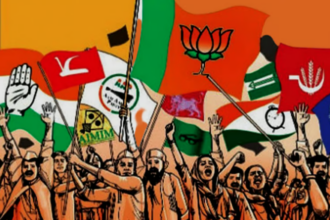

India is a vast country with great diversity in language, culture, and region. To govern such a large and diverse nation effectively, power cannot be concentrated in one authority. Federalism is a system of government that divides power between the central government and state governments. This system ensures unity of the country while respecting regional diversity and helps in the smooth functioning of democracy.
INTRODUCTION
What is Federalism?
- Federalism is a system of government in which power is divided between a central authority and various constituent units (states/regions).
- The Constitution clearly defines the powers of different levels of government.
- Each level of government has its own jurisdiction and is independent in its own sphere.
Key Features of Federalism
- Two or more levels of government
- One at the national (central) level
- Others at the state/regional level
- Division of powers
- Powers are divided by the Constitution.
- No level can change this division unilaterally.
- Written Constitution
- Federal systems have a written Constitution.
- Supremacy of the Constitution
- The Constitution is the supreme law of the country.
- Independent Judiciary
- Courts settle disputes between different levels of government.
- Financial autonomy
- Different levels have their own sources of revenue.
Why is Federalism Needed?
- Helps in better governance in large countries.
- Allows diversity (language, culture, region) to coexist.
- Brings government closer to people.
- Prevents concentration of power at one level.
Types of Federations
- Coming Together Federation
- Independent states come together to form a bigger unit.
- Example: USA, Australia
- Holding Together Federation
- A large country divides power between centre and states.
- Example: India
India and Federalism
- India is a federal country with three levels of government:
- Union Government
- State Governments
- Local Governments (Panchayats and Municipalities)
Topic-1: What is Federalism?
Meaning of Federalism
- Federalism is a system of government in which power is divided between a central authority and different constituent units of the country.
- These constituent units may be called states, provinces, or regions.
- The Constitution clearly defines the powers and functions of each level.
Main Features of Federalism
- Two or more levels of government
- One level is for the entire country (Union/Central Government).
- Other levels are for states or regions.
- Same citizens, different jurisdictions
- The same citizens are governed by more than one level of government.
- Each level has its own area of authority.
- Constitutional division of powers
- Powers are clearly mentioned in the Constitution.
- No level of government can change these powers on its own.
- Supremacy of the Constitution
- The Constitution is the supreme law of the land.
- Independent Judiciary
- Courts resolve disputes between different levels of government.
- Financial autonomy
- Each level has its own sources of revenue.
Objectives of Federalism
- To protect and promote unity of the country.
- To accommodate regional diversity.
- To share power and avoid centralisation.
Examples of Federal Countries
- India
- USA
- Australia
- Canada
Topic-2: What Makes India a Federal Country?
India is a federal country because the Indian Constitution clearly provides for a division of powers and independent functioning of different levels of government.
1. Two or More Levels of Government
- India has three levels of government:
- Union (Central) Government
- State Governments
- Local Governments (Panchayats and Municipalities)
2. Division of Powers
- The Constitution divides powers between the Union and the States.
- This division is given in three lists:
- Union List – Subjects of national importance (e.g., defence, foreign affairs)
- State List – Subjects of state importance (e.g., police, agriculture)
- Concurrent List – Subjects of common interest (e.g., education, forests)
3. Written and Supreme Constitution
- India has a written Constitution.
- The Constitution is the supreme law of the land.
- Neither the Centre nor the States can violate it.
4. Rigid Constitution
- The Constitution cannot be amended easily.
- Major changes in the division of powers require:
- Approval of the Parliament, and
- Consent of at least half of the State legislatures.
5. Independent Judiciary
- The Supreme Court and High Courts ensure:
- The Constitution is followed.
- Disputes between Centre and States are resolved fairly.
6. Financial Autonomy
- Both Centre and States have separate sources of income.
- Taxes are divided between different levels of government.
Topic-3: How is Federalism Practised?
Federalism in India is practised through constitutional arrangements and political processes that ensure power sharing between different levels of government.
1. Linguistic States
- The creation of states on the basis of language strengthened federalism.
- It made administration easier and helped people feel more connected to their state.
- Example: Formation of states like Andhra Pradesh, Tamil Nadu, Maharashtra.
- It promoted unity while respecting diversity.
2. Language Policy
- India has no national language.
- Hindi is identified as the official language, but English is also used for official purposes.
- 22 languages are recognized in the Eighth Schedule of the Constitution.
- States are free to choose their own official language.
- This flexible language policy avoids conflicts and supports federalism.
3. Centre–State Relations
- Over time, Centre–State relations have become more cooperative.
- Earlier, the central government had more power.
- After 1990, the rise of coalition governments:
- Increased the role of states in national decision-making.
- Strengthened federalism.
Topic-4: Decentralisation in India
- Decentralisation means the transfer of power from central and state governments to local governments.
- It aims to bring decision-making closer to the people.
Need for Decentralisation
- Large population makes governance from one place difficult.
- Local problems are better understood by local people.
- Encourages people’s participation in democracy.
- Reduces burden on central and state governments.
Local Government in India
India has two levels of local government:
1. Rural Local Government (Panchayati Raj)
- Gram Panchayat (village level)
- Panchayat Samiti / Block Samiti (block level)
- Zila Parishad (district level)
2. Urban Local Government
- Municipalities (small towns)
- Municipal Corporations (big cities)
Constitutional Status of Local Governments
- 73rd Constitutional Amendment Act (1992):
- Made Panchayati Raj a part of the Constitution.
- 74th Constitutional Amendment Act (1992):
- Gave constitutional status to Urban Local Bodies.
Key Features of Decentralisation
- Regular elections to local bodies.
- Seats reserved for:
- Scheduled Castes (SCs)
- Scheduled Tribes (STs)
- At least one-third seats for women
- State governments are required to share powers and revenue with local bodies.
Importance of Decentralisation
- Strengthens democracy at the grassroots level.
- Improves accountability and transparency.
- Promotes inclusive development.
Conclusion
Federalism has played a crucial role in strengthening Indian democracy. Through the division of powers, independent judiciary, linguistic states, and decentralisation, India has successfully balanced unity with diversity. The practice of federalism ensures participation of people at all levels of government and makes governance more responsive and inclusive. Thus, federalism is the foundation of India’s democratic system.
Detailed notes of other chapters:
Power Sharing: Class-10th Civics Chapter-1 ( Easy NCERT Notes )